In early July 2025, the Government announced its plans to conduct a Comprehensive Expenditure Review (CER) with the goal of cutting operating costs by up to 15%. Cuts of this magnitude rarely come without meaningful impacts on frontline programs, services, and the professionals who deliver them.
As the CER and budget process has unfolded, the Government has undertaken Work Force Adjustment (WFA) processes across most departments and agencies. Additionally, the Government has announced other programs to manage staff reduction or mobility which may be relevant to members, some of which represent voluntary options for members to pursue, however these have yet to be approved by Parliament:
The first round of the WFA process has already taken place at IRCC and no FS were affected. However, on January 18, all PAFSO members in the FS-03 and FS-04 employees pools received notice that their position was deemed “affected”. On April 29, the FS-03 group at GAC was notified that their affected status has been rescinded. However, the FS-04 group remains affected, and we continue to recommend that those members follow the guidelines below as they wait to be notified formally of their opting status.
It is important to know that your collective agreement has protections against job cuts. The Employer must ensure that employees are treated equitably and given every opportunity to continue their careers. This FAQ outlines your rights and options as a worker facing these challenges. For more information about the process, you can consult the NJC’s Work Force Adjustment Directive as well as the Government of Canada’s Workforce adjustment in the core public administratio
As noted, the FS-04 group remains affected at GAC and are awaiting formal notification regarding their opting status. Until that time we recommend that you follow the guidelines laid out below:
Get informed and ask questions about your particular situation and your options from both your PAFSO and the Employer.
After becoming informed, seriously consider all the options available to you with particular emphasis on what the best option is for you, given the situation. The WFA Directive requires you to make difficult choices, and the choice that each must make depends on your individual circumstances.
Ensure that you respond to requests from the Employer within the specified deadlines. Not doing anything will make the situation worse and potentially force you to accept an option that isn’t the best one for you.
If you are deemed surplus and your choice is to remain employed by the federal government, you must actively seek alternate federal government employment and seriously consider all job offers. Be assertive in questioning your departmental human resources advisors about what they are doing to help you find new employment in another department or agency.
Make sure you can be easily contacted by both PAFSO and your Employer.
Union protections and processes are the most important resource assisting you through the job loss or transition process and you have the right to representation throughout, from before the process starts until after it ends.
WFA is the term used to describe a process for reducing indeterminate positions in the core federal public service, agencies and separate Employers. The process was negotiated at the National Joint Council (NJC) as an important employment protection measure. Its main purpose is to protect the employment of our members.
The WFA process is outlined in the NJC’s directives and forms part of your collective agreement (Article 42.02) under the By-Laws of the National Joint Council.
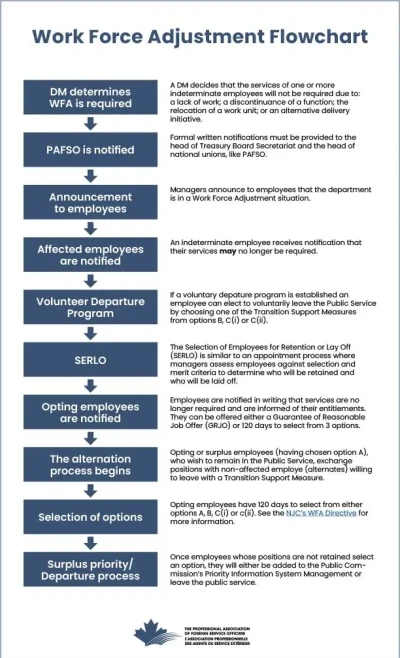
Work Force Adjustment is a situation that occurs when a deputy head decides that the services of one or more indeterminate employees will no longer be required beyond a specified date due to one of the following factors:
- A lack of work
- The discontinuance of a function
- A relocation of a work unit in which the employee does not wish to participate
- An alternate delivery initiative, including:
- the service is being transferred to another level of government
- public-private partnerships (P3s)
- contracting out and privatization of your work
Budget cuts most often take the form of a discontinuance of a function, which refers to the elimination of a specific job function or activity within a federal department or agency. Positions associated with the discontinued function may be declared surplus. Employees occupying these positions may be affected by the WFA process.
Departments and organizations must:
- Consult with PAFSO as soon as possible.
- Maximize employment opportunities for indeterminate employees.
- When possible, provide alternative employment opportunities and give employees every “reasonable opportunity” to continue their careers in the public service.
- Make sure employees are treated equitably.
- Establish joint Work Force Adjustment Committees.
- Review the use of private temporary agency personnel, consultants, contractors, term employees and all other non-indeterminate employees and where practicable not re-engage them when it will facilitate the appointment of surplus or laid off persons.
- Identify situations where retraining can help workers continue their careers in the public service.
- Advise employees in writing about their status and any change to it.
- Actively cooperate with the Public Service Commission and other departments/ organizations. Interdepartmental cooperation is essential to maximize employment opportunities, although an organization’s first priority is to find jobs for workers in-house.
Additional Employer obligations can be found in Part I of the WFA Directive.
In a workforce adjustment situation, it’s important to be proactive and investigate other potential employment opportunities within the federal public service. Once it’s clear that a work force adjustment is inevitable, employees are obliged to:
- Actively seek alternate employment in cooperation with their department and the Public Service Commission.
- Actively seek out information about their entitlements.
- Submit any documents (like résumés) or additional information that could help the Employer to find them new work.
- Ensure that they can be contacted easily.
- Attend appointments made for referrals.
- Seriously consider training and job opportunities.
- Be aware of timelines and proactively consider options when they are required to make decisions.
Now that our FS-03 and FS-04 PAFSO members have been informed by GAC, we recommend that our members follow these general guidelines:
Get informed and ask questions about your particular situation and your options from both your PAFSO and the Employer.
After becoming informed, seriously consider all the options available to you with particular emphasis on what the best option is for you, given the situation. The WFA Directive requires you to make difficult choices, and the choice that each must make depends on your individual circumstances.
Ensure that you respond to requests from the Employer within the specified deadlines. Not doing anything will make the situation worse and potentially force you to accept an option that isn’t the best one for you.
If you are deemed surplus and your choice is to remain employed by the federal government, you must actively seek alternate federal government employment and seriously consider all job offers. Be assertive in questioning your departmental human resources advisors about what they are doing to help you find new employment in another department or agency.
Make sure you can be easily contacted by both PAFSO and your Employer.
Union protections and processes are the most important resource assisting you through the job loss or transition process and you have the right to representation throughout, from before the process starts until after it ends.
The Deputy Head must notify you in writing that your services may or will no longer be required, depending on the situation. The notice must also include whether you:
- Are officially “affected” and if a process for determining who will be laid off is required,
- Will receive a guarantee of a reasonable job offer, and
- Have access to the opting provisions in the WFA Directives.
Depending on the situation and if the jobs being eliminated are unique, you may be notified that your job will be eliminated and that you will have access to the opting provision of the WFA Directive at the same time the notice is given.
For those who essentially perform the same functions as others, a system called the Selection of Employees for Retention or Layoff (SERLO) will be used to determine who will be retained and who will be laid off. In this instance affected members’ jobs will be retained or eliminated subsequent to that process.
Beyond the initial notification, there are a number of other important notices to be issued during the WFA process. These include surplus letters, job offers, opting decisions, requests for résumés and other personal information, as well as job interview notices. Many of these will specify timelines for responding or making a choice. It is very important for you to respond to the notices by the deadlines provided.
An affected employee is an indeterminate employee who has been informed in writing that his or her services may no longer be required because of a work force adjustment situation.
A surplus employee is an indeterminate employee who has been formally declared surplus, in writing, by his or her deputy head.
An opting employee is an indeterminate employee whose services will no longer be required because of a work force adjustment situation and who has not received a guarantee of a reasonable job offer from the deputy head and who has 120 days to consider the options outlined by the WFA Directive.
Opting employees who are not in receipt of the guarantee of a reasonable job offer from the deputy head will have access to the choice of options below:
Option A
- 12-month surplus priority period in which to secure a reasonable job offer.
- The employee will be laid off if they have not been appointed or deployed by the end of 12-month period.
- If you offer to resign before the end of the 12-month surplus priority period, the deputy head may authorize a lump-sum payment equal to a maximum of 6 months of the pay of your substantive position. This sum cannot exceed the maximum of what you would have received if you had selected option B (TSM).
- At your request, the 12-month surplus priority period shall be extended by the unused portion of the 120-day opting period that remains once you have selected this option.
- This is deemed to be the chosen option if the employee fails to select an option.
Option B
- Transition Support Measure (TSM).
- Payment based on employee’s years of service in the Public Service in exchange for resignation.
- The TSM shall be paid in one or two lump-sum amounts over a maximum two-year period.
Option C (i)
- Transition Support Measure (TSM) + education allowance ($15,000 or $17,000)
- Allowance for receipted expenses for tuition fees, costs of books, and relevant or mandatory equipment (according to the WFA Directive).
Option C (ii)
- Transition Support Measure (TSM) + Education allowance ($15,000 or $17,000) + Leave without pay (LWOP)
- Allowance for receipted expenses for tuition fees, costs of books, and relevant or mandatory equipment (according to the relevant WFA Directive).
- Delay departure date and go on LWOP while attending learning institution (maximum of 2 years).
On Friday December 12, 2025, PAFSO President Pam Isfeld, Executive Director Dan Whalen, and Labour Relations Team Leader Bertrand Myre held a webinar to discuss current and potential Workforce Adjustment (WFA) affecting Foreign Service (FS) officers at Global Affairs Canada (GAC) and IRCC, the related Early Retirement Incentive (ERI), and how PAFSO will support members through a long, uncertain process.
Situation and uncertainty
- The federal Budget Implementation Act did not pass before the holidays, which delays or complicates timing for WFA measures and the ERI; departments are nonetheless proceeding with their WFA planning.
- Senior managers at GAC, IRCC and Treasury Board are themselves receiving shifting signals from the centre creating a high degree of uncertainty on timelines, scope, and tools like ERI.
- WFA at IRCC is ongoing, and a new round is likely to begin in the new year, expected to mainly target EX positions. GAC has announced letters will go out in mid-January covering the full three-year WFA period; FS impacts are still not concretely defined.
Employer intentions and WFA mechanics
- The employer is signalling a preference for voluntary departures and avoiding the Surplus/Surplus Lay-off (SERLO) process, using tools like ERI and mobility options rather than involuntary layoffs where possible.
- Approximately three times as many “affected” notices as targeted position cuts may be issued, to create a broad pool of potentially mobile or departing employees.
- WFA applies to positions, not to assignments; being “affected” means your group/level/work unit is at risk, not that you are automatically losing employment.
ERI, voluntary departure, and SERLO
- The ERI is intended as a relatively simple route for eligible employees close to retirement (e.g., sufficient age and service) to leave with pension penalties waived, but its coming-into-force depends on the Budget Implementation Act.
- If ERI is not in place before WFA decisions, members may instead rely on existing WFA options such as Transition Support Measures (TSM) and the education allowance, which generally require being an “opting” or affected employee or alternation.
- Although the WFA provisions do include a waiver of pension penalties, that waiver is limited to employees age 55 (Group 1) or 60 (Group 2) and above (unlike the ERI, which proposes to waive penalties for those 50 and 55 respectively). Members should carefully review the primary sources provided by the Employer and ensure they consider the various implications for their individual situations.
- Alternation (swapping with a surplus employee) is a key mechanism to increase voluntary exits and protect others from layoff; it is possible between FS and non-FS employees where essential qualifications are met, though managers retain discretion in approving alternations.
Impact on FS group, careers, and equity
- Because FS is a pooled, rotational group with complex classification and assignments, it is administratively difficult for the employer to run a classic WFA against FS; PAFSO is using this complexity to argue for minimizing FS job losses and avoiding SERLO.
- Management is expected to look first to those close to retirement and to business lines being reduced (e.g., some international assistance programming) while recognizing ongoing or growing needs in areas like trade; PAFSO’s position remains that “an FS is an FS” and every FS box should, as a priority, be filled by a substantive FS who wants to stay.
- Equity issues such as treatment of employees on leave, language requirements, and potential discriminatory impacts (e.g., by age, gender, caregiving status) are flagged; a subcommittee will address WFA for employees on leave, and PAFSO will monitor for breaches of human rights or unfair treatment.
Guidance to members and PAFSO support
- Members are urged not to make drastic decisions prematurely, but to: stay informed on the Workforce Adjustment Directive; update second-language skills and SLE results; and reflect on the core choice “am I inclined to stay or to go?” as a first-order decision.
- PAFSO has a dedicated labour relations team (four advisors plus the Team Leader) ready to provide individual advice, representation, and to challenge misapplication of WFA processes and procedures.
- Key resources include: the WFA FAQ and flowchart on the PAFSO website; President’s regular messages; recent webinars on personal career planning and on WFA/ERI; and the info@pafso-apase.com channel for case-specific questions, with a follow-up webinar planned for late January once notification letters and further guidance are issued.
To help you better understand the steps involved in a WFA situation, we have prepared a simple PDF flowchart. You can click here to download a copy.